
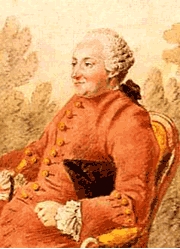
On this date in 1723, Paul Henri Baron von Holbach, one of the Enlightenment’s most passionate atheists, was born in Edesheim, Germany, into a Catholic family. An uncle who became a wealthy nobleman brought Holbach to Paris when he was 12, educated him and left him his fortune. Holbach studied law in Holland, returned to Paris and inherited more wealth. Holbach befriended the Encyclopedists, including Denis Diderot, and his Parisian home became a hub of the Enlightenment.
Holbach wrote several articles for the Encyclopedia and also translated German scholars, then began writing his philosophical pieces in secret. He did not sign his name to these atheistic works, so, although some were ordered to be burned in France, he was spared prosecution. He eventually inspired a “Holbachian” movement of anticlericalism and philosophical materialism.
Holbach’s writings include a series of works published in 1770 inquiring into the historicity of Jesus, the saints and other freethought subjects. Christianity Unveiled was published in 1766, The Holy Disease in 1768, System of Nature in 1770 and Le Bon sens (Common Sense) in 1772, followed by several political and moral treatises. In Common Sense, Holbach wrote that “Religion is a mere castle in the air. Theology is ignorance of natural causes; a tissue of fallacies and contradictions.”
He believed “Knowledge, Reason, and Liberty, can alone reform and make men happier.” He optimistically predicted “If the ignorance of nature gave birth to the gods, knowledge of nature is destined to destroy them.” Holbach translated and adapted many major deistic English writings. He particularly criticized Catholicism as an obstacle to freedom and the common good. D. 1789.

