

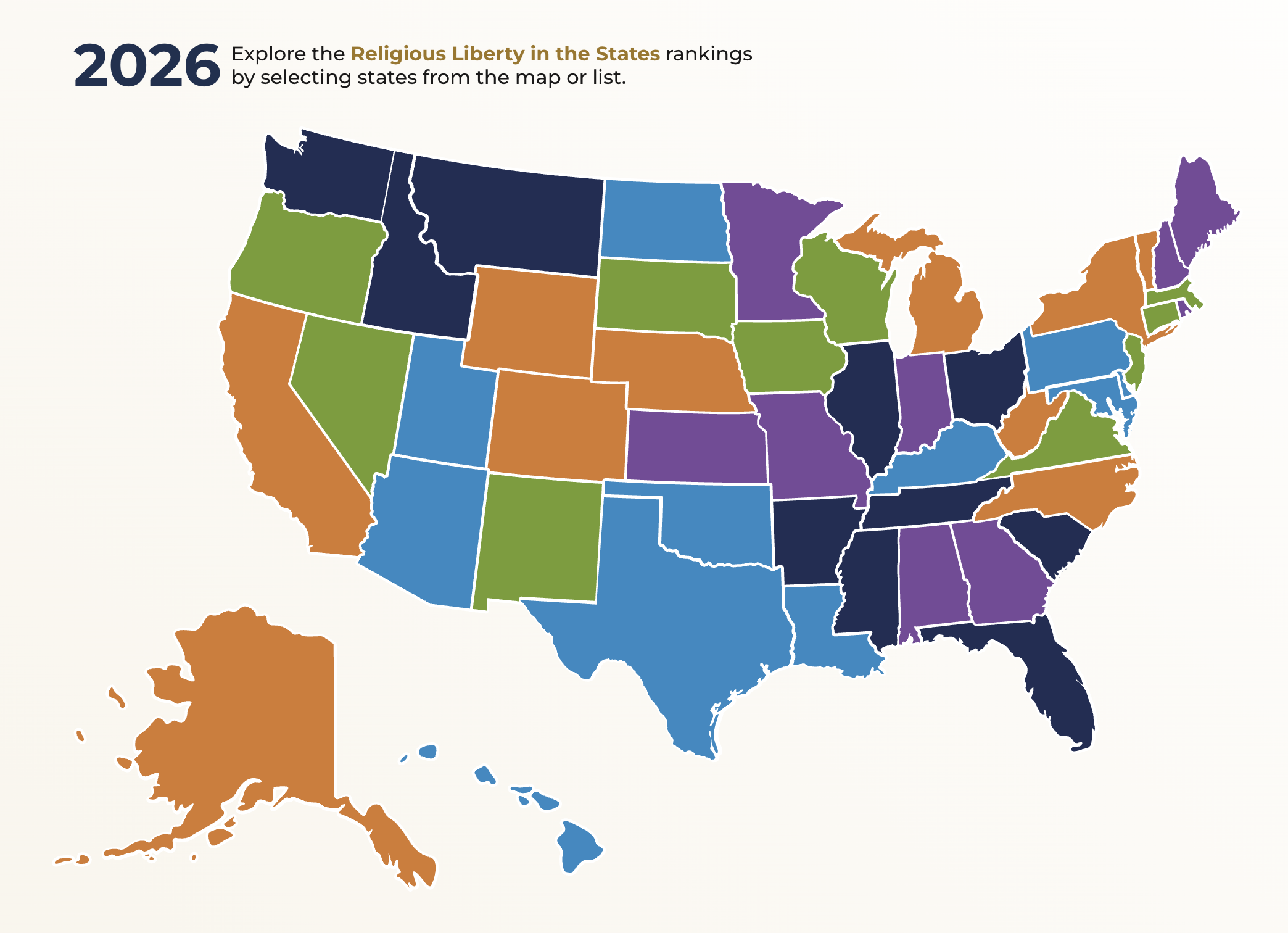
The Freedom From Religion Foundation is criticizing First Liberty Institute’s newly released Religious Liberty in the States 2026 report, arguing that it rewards states for expanding religious exemptions rather than protecting genuine religious freedom.
The report rewards states for enacting laws that allow religious individuals and organizations to opt out of generally applicable laws, including nondiscrimination protections, health care obligations and civil rights requirements.
“Americans already enjoy the constitutional right to believe, worship or reject religion as they choose,” says FFRF Co-President Annie Laurie Gaylor. “First Liberty’s index isn’t about measuring or promoting true religious freedom. It’s about measuring assaults on the constitutional separation between state and church.”
The report, released at an event hosted by Arkansas Gov. Sarah Huckabee Sanders, crowned Arkansas the nation’s top state for “religious liberty” after the state enacted legislation allowing businesses, religious organizations and others to refuse participation in weddings based on religious objections.
The report openly encourages lawmakers to use its rankings as a blueprint for passing additional religious exemption laws and invites legislators to work with First Liberty attorneys to enact them.
Sanders celebrated Arkansas’ top ranking by erroneously declaring, “Our rights come from God, not government.”
FFRF argues that the statement perfectly captures the ideological problem with this report, because constitutional rights are secured by the Constitution, which is godless, and enforced by civil, not religious courts.
“Americans enjoy freedom of religion precisely because our government does not claim to derive its authority from a deity,” Gaylor adds.
Among the policies that improve First Liberty’s ranking of states are laws that allow:
- Businesses to refuse participation in same-sex weddings.
- Government officials to decline participation in weddings because of religious objections.
- Healthcare providers to refuse to provide abortions, sterilizations, contraception, genetic counseling and other medical services.
- Religious foster-care agencies to discriminate while remaining eligible for funding by government programs.
- Expanded Religious Freedom Restoration Acts.
- Religious exemptions from labor union participation.
- Additional protections allowing religious entities to avoid compliance with generally applicable laws.
“These are not measures of religious freedom,” Gaylor notes. “They are measures of religious privilege. The report consistently treats exemptions from following civil rights laws for religious reasons as if they are synonymous with liberty.”
The report praises Arkansas’ HB 1615, which allows government officials to refuse to participate in weddings for religious reasons, as model legislation for other states to copy. While public employees have limited religious accommodation rights, they cannot constitutionally deny members of the public equal access to government services.
The report celebrates Tennessee’s sweeping medical conscience law as one of the nation’s strongest religious liberty protections and encourages its adoption elsewhere. FFRF’s legislative arm, the FFRF Action Fund, opposed the legislation, warning that it “allows health care providers and insurance companies to refuse treatment based on religious objections — and even worse, patients wouldn’t be informed that these treatments aren’t available to them.” The Action Fund further noted that the bill “blatantly enables religious-based discrimination, bringing real harm to reproductive freedom and LGBTQ+ rights in Tennessee.”
While First Liberty portrays states such as Arkansas and Tennessee as national leaders, its report penalizes such states as New York, California and Connecticut, not because residents lack the freedom to practice their faith but largely because they have chosen not to enact expansive religious exemption statutes.
FFRF notes that the report arrives amid an increasingly coordinated Christian nationalist effort to reshape state law by granting religion, particularly conservative Christian adherents, preferential treatment.
Sanders, who crows about her state’s ranking in this report, has embraced Christian nationalist rhetoric and repeatedly rejected Establishment Clause concerns. These include dismissing FFRF’s objection to her proclamation closing state offices for Christmas with an explicitly theological account of the Christian story of Jesus’ birth, divinity, crucifixion, resurrection and anticipated return “in glory,” while instructing state employees to spend the holiday “giving thanks for Christ’s birth.”
“True religious liberty protects every American’s freedom of conscience,” Gaylor says. “It does not guarantee a religious right to discriminate, ignore civil rights laws or receive special treatment from the government. That’s the distinction First Liberty’s report intentionally obscures.”
FFRF will continue monitoring and opposing legislation promoted by First Liberty and similar organizations as they seek to replicate these discriminatory religious exemption laws across the country.
The Freedom From Religion Foundation is a U.S.-based nonprofit dedicated to defending the constitutional principle of separation between state and church and educating the public on matters relating to nontheism. With about 41,000 members, FFRF is the largest association of freethinkers (atheists, agnostics and humanists) in North America. For more information, visit ffrf.org.
